

How To Help Your Flight Attendant When They're On 'Crotch Watch'
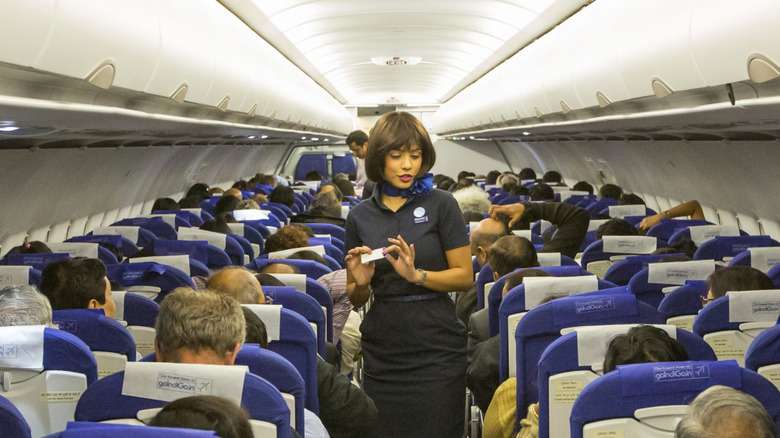
If you're an experienced flier, you're likely aware of a flight attendant's typical responsibilities, such as serving food and performing the pre-flight safety demonstration. But, I've been a flight attendant for over a decade, and I can tell you with certainty that most passengers only know of a small portion of what we're actually responsible for. On the surface, most of our tasks seem service related, but our primary job function has always been safety. This includes ensuring that everyone is adhering to safety protocols like wearing a seatbelt during the critical phases of flight: takeoff, landing, and whenever the pilot illuminates the seatbelt sign during cruise.
To help manage our many responsibilities, flight attendants use our own language of sorts, largely due to the fact that passengers could be listening at any moment. This language features shorthand phrases like "crotch watch," which isn't nearly as risqué as it sounds. A flight attendant on crotch watch is performing seatbelt compliance, or passing through the cabin to make sure everyone is strapped in while the sign is lit.
There's one major thing you can do to help us out when completing the crotch watch process: return to your seat as soon as possible after the seatbelt chime rings. You'll earn extra points for securing your seatbelt over clothing, jackets, scarves, and blankets. That way, we don't have to interrupt your movie or wake you up from a nap to check that your seatbelt is fastened. Of the many frustrating aspects of flying that exist today, there's little worse than being jolted awake after you've finally dozed off.
Why it's important to mind the seatbelt sign on a flight
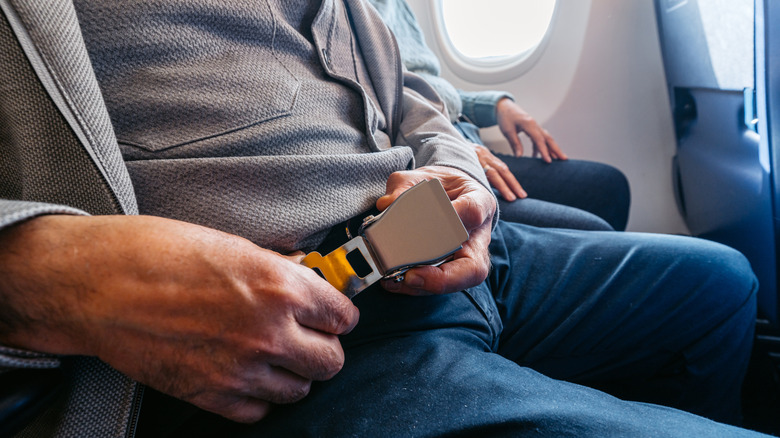
While it's natural to want to stretch your legs or use the lavatory an hour or two into a flight, it's best practice to stay seated with your seatbelt on as often as possible, even when the sign is no longer illuminated. The reason for this is very simple: there is always the potential for unexpected turbulence. The National Weather Service calls turbulence "one of the most unpredictable of all the weather phenomena that are of significance to pilots." Turbulence can cause slight to extreme changes in altitude at any given time; with this in mind, pilots often turn the seatbelt light on as a precaution.
Severe turbulence can lead to injuries, which is why flight attendants must walk through the cabin to confirm that all seatbelts are fastened every time the sign lights up. We're not trying to pester you, as we know that traveling is already stressful enough. You may be a nervous flyer or feel uncomfortable due to wearing tight-fitting clothing. Even so, strapping in whenever possible is the only way to ensure you won't be thrown from your seat if the plane hits a few bumps along the way.
"You don't even need to have the seatbelt on snug and tight, just having it on loosely to give it a little restraint," Brian Strzempkowski, interim director at the Center for Aviation Studies at The Ohio State University, told USA Today in 2023. "If you hit a bump, you might move an inch or so, but it'll keep you from coming out of your seat and hitting your head." For our own safety, flight attendants sit on our hands during takeoff and landing, but passengers aren't required to do the same.